This site is password protected.
Called to Study · Grounded in Scripture · Engaged in Culture
"For this is the will of God, that by doing good you should put to silence the ignorance of foolish people. Live as people who are free… Fear God. Honor the Emperor."— 1 Peter 2:15–17 · LCRL's Guiding Scripture
Five interconnected teachings — from personal vocation to public engagement — that equip you to stand with courage as a Champion for Religious Liberty.
What does it truly mean to be "called"? Rooted in 1 Peter 2:15–17, this opening explores the courageous vocation of every Champion.
Four foundational behaviors every Champion must practice. Session 2 introduces Pillar One: the commitment to Study.
"Mom & Pop Paper #1" — the foundational concept behind everything LCRL does. God works two distinct ways in the world.
Chapters 1–3 of Luke Goodrich's essential book. What is religious freedom — and how do we get it right?
Current events, watchdog resources, school board meetings, and legislative tracking — putting knowledge into action.
Ten questions to test and solidify what you've learned. Immediate feedback on every answer. See how you score.
Dr. Gregory Seltz often heard seminary students say "I want to be called" — meaning health insurance, benefits, security. But being called means something far more demanding.
In the early church, the bishop was often the only public Christian — the last one willing to stand when all hell breaks loose. That is what it means to be called. As a Champion for Religious Liberty, your vocation demands that same courage.
1 Peter tells us to "live as people who are free, not using your freedom as a cover-up for evil, but living as servants of God." The vocation of Champion is a courageous one — a person who will not be silent in the face of evil.
Through the vocation of Champion, other people will be saved — simply because you have the courage to be yourself when all hell breaks loose.
This passage is LCRL's primary guiding scripture. It holds three distinct commands for the Champion citizen:
The freedom we have in Christ is the foundation for every liberty we steward in America.
These are not programs or events — they are daily behaviors. If we are going to be strong and effective Champions, we must practice these consistently.
Commit to being informed. Read, listen, learn.
Intercede for leaders, cases, and community.
Build relationships that open doors for truth.
Show up — in school boards, legislatures, and neighborhoods.

To be a faithful Champion, you don't need to speak in front of crowds. Most of your conversations will be one-on-one. But you must be informed enough to have them with confidence and clarity.
Study doesn't require hours each day. Setting aside a little bit of time three times a week will likely suffice. Here's what that looks like:
You don't have to be an attorney or a lobbyist. Many Champions say "I can't speak in front of people" — and that's fine. That doesn't mean you can't speak at all.
The goal of Study is to equip you for the conversations already in your life — with neighbors, coworkers, family members — and to recognize religious liberty issues when they appear.
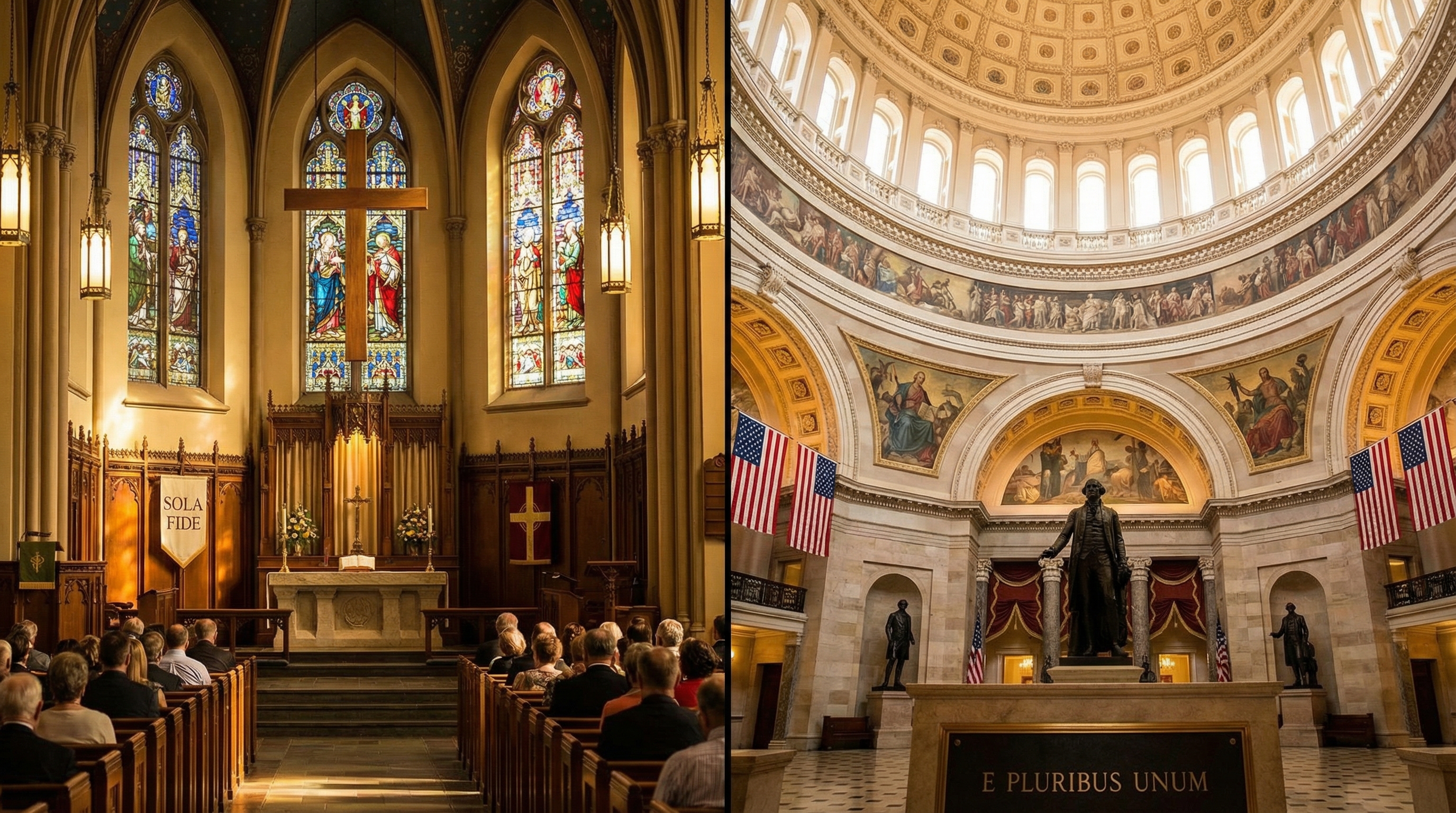
The foundational concept behind everything LCRL does. Simple to explain, profound in impact — and the lens through which every religious liberty question must be viewed.
When government oversteps into the Right Hand Kingdom — telling churches what to preach, dictating religious belief, or punishing conscience — it violates the boundary God himself set. This is precisely the threat that Champions are trained to identify and resist.
Our Founding Fathers were shaped by this same principle: that the State's role is to preserve and protect — not to save, control belief, or coerce conscience.
Jesus draws a clear line: Caesar has a role, and God has a role — and they are not the same role. The brilliance of this teaching is how it limits Caesar. Not everything belongs to Caesar. Conscience, belief, worship — these belong to God.
This is not a teaching about tax compliance. It is the defining text for understanding why government does not have the authority to control your faith.
Mom & Pop Paper #1 is meant to be simple enough to explain to your spouse without looking at your notes. Practice this:
Luke Goodrich's essential guide to religious liberty in America. These first three chapters answer the foundational question: What is religious freedom?
Goodrich opens with a frank assessment: many Christians approach religious liberty with one of three flawed frameworks. Recognizing which group you've belonged to — and why each is inadequate — is the first step toward a better way.
Assume Christians founded this nation and Christian faith should always be prominent in public life.
Believe America has no special standing and that religious liberty is used to oppress other faiths.
Simply unequipped — unable to explain religious freedom or take a stand when it matters most.
Religious liberty is about biblical justice — rooted in the nature of God and the nature of humanity. Because God never coerces anyone into relationship with Him, no government has the authority to coerce belief. That is the foundation.
Religious liberty is not defined by the Greeks, the Romans, or the U.S. Constitution. Goodrich makes the stunning case that it is rooted in God's own design for humanity — and walks through three key pillars to prove it.
Being made in God's image means we reflect His heart and nature — not perfectly, but genuinely. God is a relational being who never stops pursuing humanity. He never coerces. He always invites.
If God himself refuses to coerce belief, then no government has grounds to do so either. Religious liberty flows from this foundational truth.
Goodrich describes a yearning built into every human being — a thirst that cannot be satisfied by substances, success, or status. When people try to fill this void, they are never truly satisfied.
This is not about earning salvation — that is God's work alone. But it explains the restlessness of human hearts when separated from their Creator.
Goodrich draws a distinction between our vertical relationship (God and the person) and the horizontal (person to person). Government's legitimate role is the horizontal — ensuring fair laws, impartial judges, protection for the vulnerable.
It is not the government's role to control the vertical. The moment government starts dictating how — or whether — you relate to God, it has overstepped its God-given mandate.
Israel's theocratic government was unique and unrepeatable — a specific covenant with a specific people for a specific time. It cannot serve as a template for modern civil government. Goodrich spends several pages unpacking why.
Government is not equipped to adjudicate theological truth. The moment it tries, it inevitably abuses power. Government is a servant of God for civil order — not a theological enforcer.
No — religious liberty does not mean anyone can do anything in the name of religion. Human sacrifice, for example, is not protected. Goodrich addresses the limits extensively later in the book. Freedom has boundaries; it does not have no boundaries.
Goodrich writes from a courtroom perspective: what good is our argument if we can't convey it persuasively? Chapter 3 gives you three field-tested arguments that work — even without quoting Scripture.
Robert Putnam's research found that the #1 predictor of civic engagement is religious community involvement — not education, income, or location. And religious communities contribute over $1 trillion annually to U.S. charities.
When the government gains power over religious conscience, every other freedom is at risk. History shows that the erosion of religious liberty is often the first sign of broader totalitarianism.
The most important relationship any person can have is with God. No government has the authority to control or prevent that relationship. This is not a Christian argument — it is a human one.
A public school bans all hats. A conservative Jewish boy enrolls, accustomed to wearing his yarmulke out of reverence for God. Religious liberty isn't simple anymore. The goal: the government defaults to leaving religion alone — within reasonable limits.
Champions don't just study — they show up. Here's how your Chapter begins the work of watching, praying, and engaging your local community.
Are there agenda items at your local school board that affect religious expression, curriculum, or parental rights? Champions go first to listen and learn — then to pray — then to advocate.
ADF Legal Cases →Is your state legislature in session? Are any bills affecting religious liberty being discussed? Your Chapter should identify these, research them, and decide whether to become better informed or engaged.
Federal legislation on religious liberty moves slowly — bills can take years. Your Chapter's watchdog role is to stay alert and sound the alarm well in advance of a vote or crisis.
Goodrich opens Free to Believe with the story of Hosanna-Tabor Evangelical Lutheran Church and School (LCMS) in Redford, Michigan — sued by a former school teacher in a case that reached the U.S. Supreme Court.
The Supreme Court ruled unanimously in the school's favor, protecting the "ministerial exception." But the case illustrates exactly what Champions train for: lawsuits against Christians are becoming more frequent, more vitriolic, and closer to home.
As Goodrich observes — when most of us hear of these things happening, we yawn. We are so busy running at full tilt that we don't have the energy to care.
People who have immigrated from communist and socialist states look at what is happening in America with horror. They all say the same thing: "This is how it started for us. It starts when you let go of God. No God — no freedom."
Ten questions from Session 002. Immediate feedback after each answer. See how you score — then revisit what you missed.